Breathing Room: The Art of Kampong Spirit in Modern Interiors
How Singapore's communal heritage is quietly shaping a new wave of home design — one open threshold at a time.
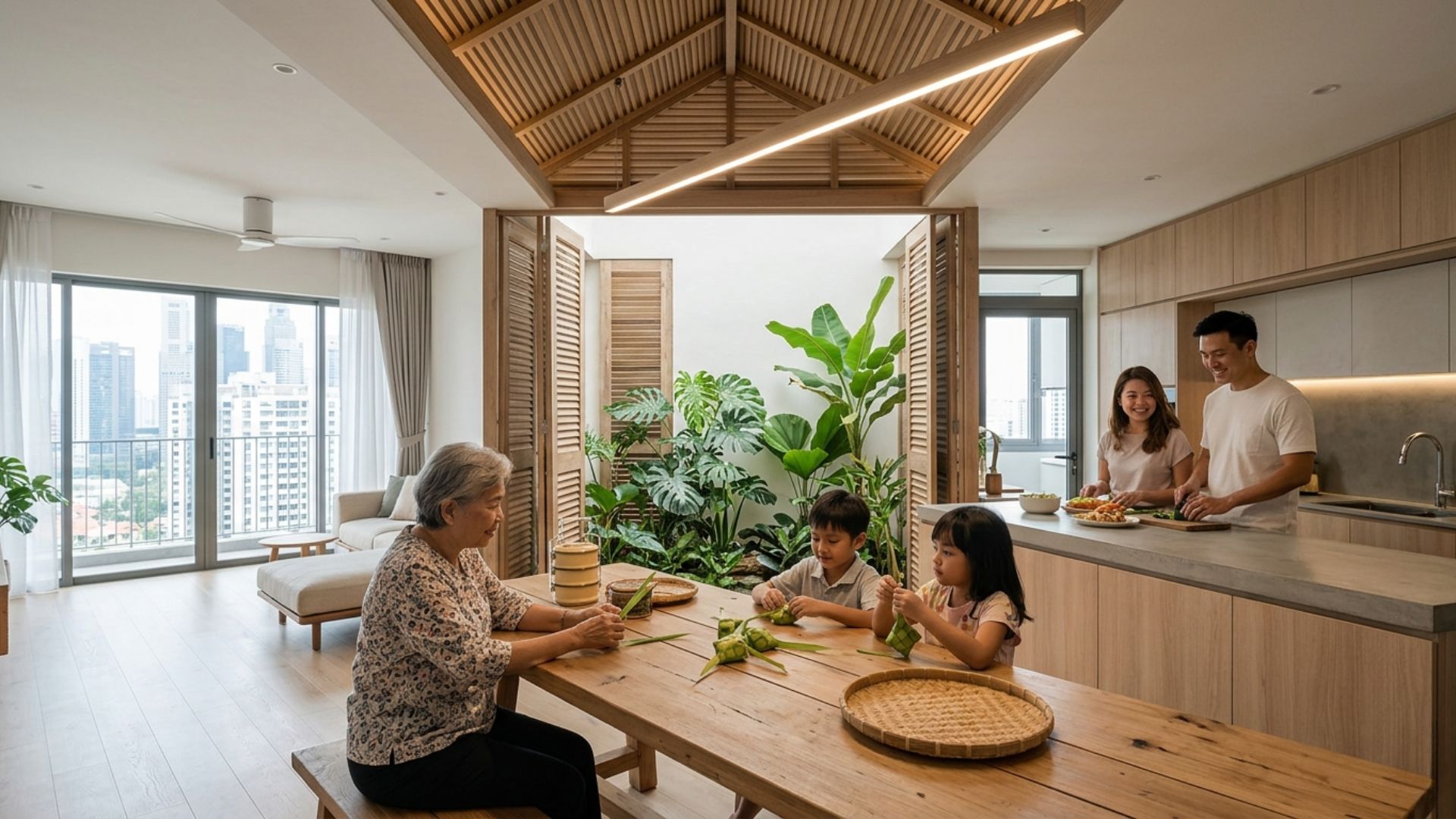
There is a word that older Singaporeans reach for when they speak of belonging — kampong. Village. A place where doors were left open, where children spilled between households, where the smell of a neighbour's curry was an invitation, not an intrusion. The kampong is largely gone from Singapore's landscape, replaced by towers of glass and efficient HDB corridors. And yet, something of its spirit persists — not in architecture, but in aspiration. Increasingly, our clients come to us not simply wanting a beautiful home. They want a home that breathes. The problem with perfect rooms For much of the past decade, Singapore's interior design conversation has been dominated by the immaculate — clean lines, seamless joinery, surfaces that show no evidence of living. Instagram rewarded this, and homeowners followed. The aspiration was the hotel room: neutral, frictionless, hushed. But something was lost. The rooms felt curated rather than inhabited. Guests sat carefully. Children were cautioned. The living room, meant to gather a family, became a place no one quite relaxed in. Softness as a design strategy What we are witnessing now is a deliberate correction. Clients are asking for texture — raw linen against teak, handmade ceramic next to machine-cut stone. They are asking for warmth rather than neutrality, for rooms that look better with a little disorder. They want their grandmother's rattan chair and the new bookshelf to coexist without apology. This is not nostalgia. It is a sophisticated understanding that a home's most important function is emotional, not aesthetic. Comfort is not just a quality of cushions. It is the quality of a room that permits you to exhale. Lessons from the five-foot way Singapore's traditional shophouses offered a remarkable piece of civic design in the kaki lima — the five-foot way, a covered walkway at once private and public, belonging to the home yet offered to the street. It was an edge condition: not quite inside, not quite outside. A zone of negotiation between the household and the neighbourhood. We borrow this idea for contemporary interiors. A window seat that faces the corridor. A kitchen island positioned so that a person cooking is never excluded from the conversation in the living room. A balcony threshold that blurs the boundary between the conditioned interior and the tropical afternoon. These moments — small, almost incidental — are where a home reveals its character. Practical considerations for Singapore's climate There are, of course, real constraints. Singapore's heat and humidity punish certain materials and reward others. We have learned to trust timber species like chengal and balau for their dimensional stability. We have learned to be cautious with the polished concrete that photographs beautifully in European apartments but sweats and stains in our equatorial air. We favour jalousie windows and timber screens not merely for their aesthetic warmth, but because they manage airflow in ways that sealed glass walls cannot. An interior designed for Singapore must be in dialogue with Singapore — its light, which arrives at a low angle near the equinoxes; its daily downpours, which reset the air; its evenings, which are almost always gentler than the afternoons suggest. Making space for imperfection Perhaps the deepest insight we carry from kampong design philosophy is this: the house was never meant to be finished. It grew, room by room, in response to what life demanded. A child arrived and a partition went up. An elderly parent moved in and the kitchen was extended. The house was a record of the family's story, not a statement completed on handover day. We encourage our clients to resist the urge toward total resolution. Leave a wall unpainted — you will hang something there one day. Buy the dining table before the chairs; the chairs will come when you know how the table feels in the room. Let the home grow with you. That, in the end, is what it means to live in a place rather than merely occupy it.
Planning a renovation?
Get matched with vetted firms that fit your budget and style — free.
Get matched