Chasing shade: designing with Singapore's sun, not against it
Most homes treat our tropical light as a problem to be blocked. A growing number of designers are asking a different question — what if you let it in on its own terms?
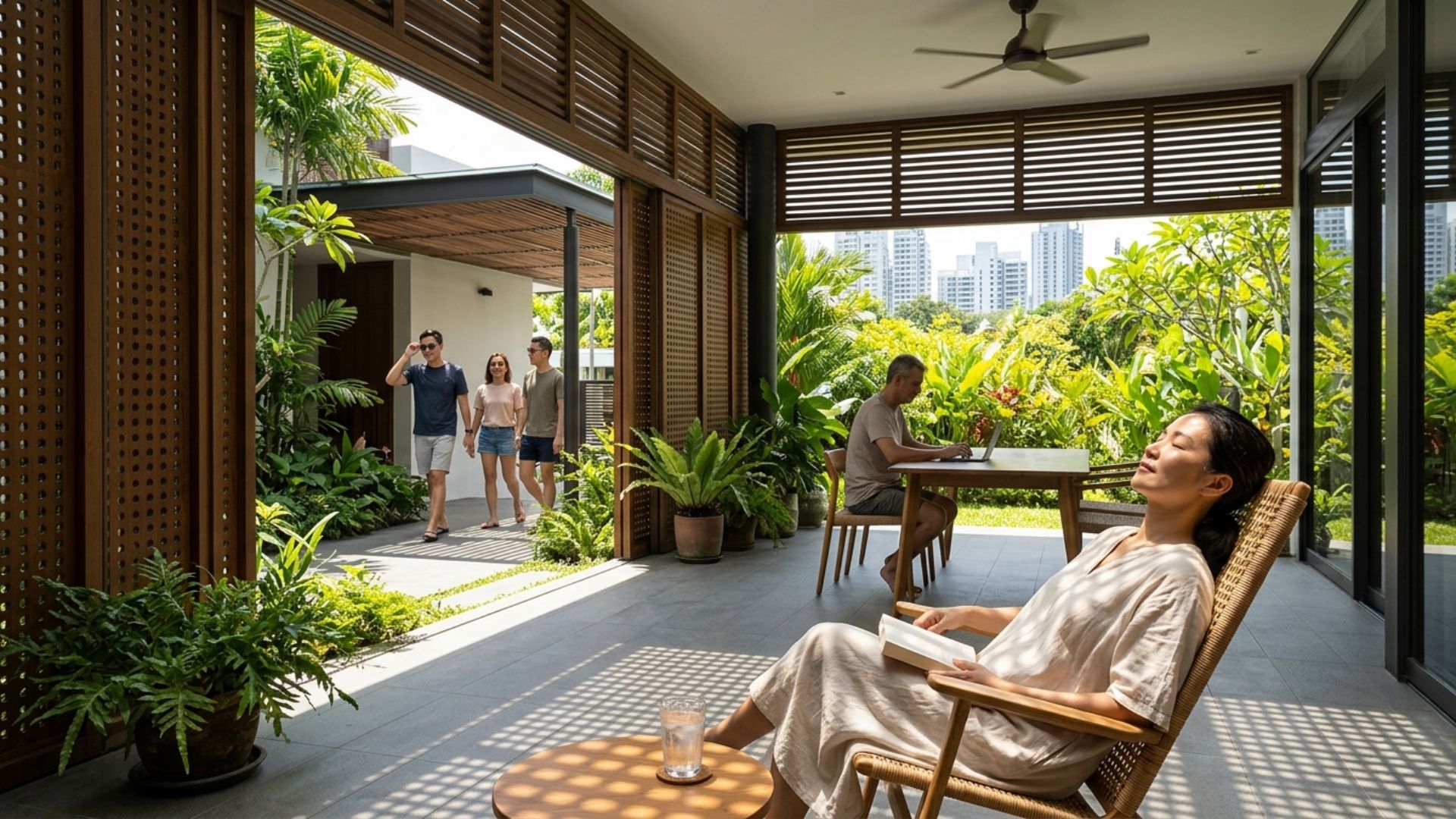
Natural light · Singapore homes Chasing shade: designing with Singapore's sun, not against it Most homes treat our tropical light as a problem to be blocked. A growing number of designers are asking a different question — what if you let it in on its own terms? Priya Subramaniam April 2026 7 min read Singapore sits just one degree north of the equator, which means our sun does not arc gently across the sky as it does in temperate climates. It climbs steeply, burns intensely, and descends quickly. The light it casts is high, white, and unforgiving — and for most of the year, the standard response inside Singapore homes is to shut it out entirely. Blackout curtains. Tinted glass. Deep overhangs. Air-conditioning set to 22 degrees. This is understandable. The heat is real, the glare is real, and the energy bills are real. But something is lost in the process. A home sealed against its climate becomes a room sealed against its place. The particular quality of a Singapore afternoon — the way light bounces off wet leaves after a two o'clock downpour, the amber warmth that arrives in the last half hour before dusk — disappears entirely from the interior experience. A different approach is gaining ground among Singapore designers: not blocking the light, but shaping it. Filtering, redirecting, diffusing. Working with the sun's arc rather than simply excluding it. "In Singapore, light is not a gentle visitor you invite in at will. It is a force of nature. The designer's job is not to fight it but to negotiate with it — to let in its warmth while protecting against its violence." Understanding the light before designing for it The first step is orientation. In Singapore, north-facing rooms receive relatively consistent, indirect light throughout the day — the most stable and generally the most desirable condition for living spaces. South-facing rooms are similar. East-facing rooms get the morning sun, which is gentler and lower in angle, casting long warm shadows that many people find beautiful. West-facing rooms receive the afternoon sun, which is the most challenging: high-angle, intense, and arriving at exactly the hour when the day's heat has accumulated. Many Singapore apartments offer little control over orientation — you receive what the building gives you. But knowing your orientation transforms how you approach every material and window treatment decision in the home. A west-facing living room does not need more curtains; it needs materials that manage heat gain rather than simply blocking light, and a layout that keeps the seating away from the glass rather than directly against it. The art of the diffuser Before glass, Singapore's traditional architecture managed light through layered screens. Timber jalousies, carved ventilation panels, deep five-foot-way overhangs, louvred shutters — each was a form of light diffusion, allowing air and a softened version of daylight to enter while blocking direct sun. The shophouse at noon is not dark; it is dappled. The light that reaches the interior has been translated by multiple surfaces before arriving, and it is better for it. Contemporary interiors can borrow this logic without replicating its historical forms. Sheer linen panels hung inside floor-to-ceiling glazing scatter direct light into something closer to a broad wash. Perforated metal screens — increasingly used as room dividers or wardrobe frontings — create moving patterns of light and shadow as the sun shifts. Ribbed and fluted glass, which has enjoyed a significant revival in Singapore bathrooms and internal windows, refracts direct light into soft vertical bands that read as animated texture on the opposite wall. Each of these is a diffuser in the architectural sense: a material that accepts harsh input and produces gentle output. The room beyond benefits from light without suffering from its intensity. "We stopped treating windows as problems the moment we stopped thinking of them as all-or-nothing. A window is not open or closed. It is a filter with many settings — and the most beautiful rooms use every one of them." Colour as a light-management tool The colours of a Singapore interior behave differently from those in a London or Copenhagen apartment, because the light source is different. European interiors are often designed around the challenge of maximising scarce natural light — pale walls, reflective surfaces, mirrors deployed to bounce light further into the room. In Singapore, this logic can work against you. A highly reflective pale interior in a west-facing unit becomes almost unbearably bright on a clear afternoon. Matte surfaces absorb rather than reflect. Warm mid-tones — terracotta, ochre, dusty olive — accept Singapore's light and return it as warmth rather than glare. Deeply saturated colours, used on a single wall or in a contained space like a study or bedroom, create zones of calm contrast that actually make adjacent bright areas feel more manageable by comparison. The dark room is not oppressive; it is a relief. We increasingly recommend that clients avoid both extremes — the all-white apartment that becomes a light box by afternoon, and the all-dark interior that feels correct in photographs but gloomy in daily life. The answer lies in contrast: light rooms with one anchoring dark element, or richly coloured rooms with one generously lit wall. The interplay between these conditions is what makes a home feel alive across the full arc of the day. Plants as living diffusers Singapore's climate is, of course, extraordinary for growing things, and there is a long tradition of bringing the outside in — through open corridors, internal courtyards, and the abundant potted plants that characterise Peranakan and colonial-era homes alike. The contemporary interior has somewhat lost this habit, favouring a few large specimen plants against clean walls over the layered, slightly overgrown domesticity of earlier eras. But plants are also light managers. A row of tall indoor plants placed before a west-facing window intercepts direct sun, scatters it through their leaves, and returns it to the interior as the soft, slightly green-tinged light that most people associate with a sense of wellbeing. The plants benefit from the intensity of the sun; the room benefits from the plants' filtration. It is a genuinely mutual arrangement, and one that no curtain can quite replicate. Accepting the heat There is one further shift in thinking that the best Singapore interiors have made, and it is perhaps the most fundamental: accepting that some parts of the home will be warm, and designing for warmth rather than fighting it at every surface. A sun-drenched window seat that is too warm to sit in at 2pm may be perfect at 7am and again at 6pm. A balcony designed with deep shade and a good overhead cover becomes liveable for far more of the year than one left open to the sky. A study oriented toward morning light and shielded from the afternoon is pleasant and cool for the hours when most people actually work. The sun is not an adversary. It is a collaborator with strong opinions. The homes that feel most alive in Singapore are the ones that have found a way to agree with it, at least some of the time.
Planning a renovation?
Get matched with vetted firms that fit your budget and style — free.
Get matched