The sixth sense of a room: designing with scent in Singapore homes
We obsess over what our homes look like. Increasingly, the designers shaping Singapore's most memorable interiors are paying equal attention to how they smell.
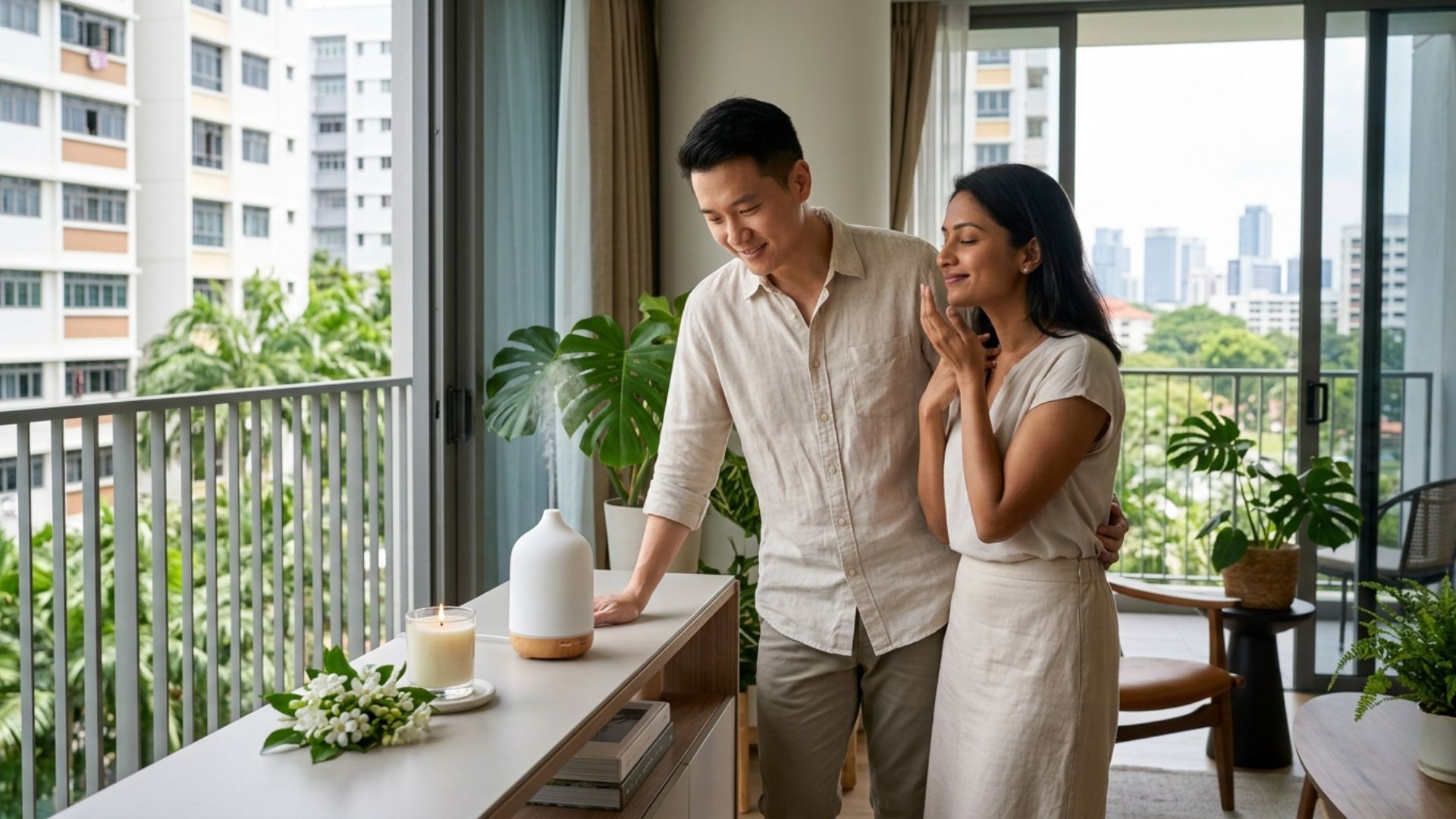
Memory is encoded in smell more reliably than in any other sense. Before you can name what you are remembering, your body has already responded — a particular warmth in the chest, a shift in the breath, the sudden presence of a place or person long gone. The smell of sandalwood and old timber. Of rain on hot pavement. Of jasmine strung at a threshold on a festival morning. Every Singapore home carries a scent, whether its occupants have chosen one or not. Most have not chosen one. The default scent of a contemporary Singapore interior is the particular neutrality of air-conditioning: cool, faintly metallic, slightly desiccated. It is not unpleasant, but it is absent — and absence is not the same as calm. A home that smells of nothing communicates, subliminally, that no one has thought about it. A home that smells of something considered communicates the opposite. A small but growing number of Singapore interior designers are beginning to treat scent not as an afterthought — a reed diffuser placed on the shelf beside the decorative objects — but as a foundational atmospheric layer, considered alongside light, texture, and sound from the very beginning of a project. "We can specify every material in a room down to the micron. We can control every lumen of light. And then we ignore entirely the sense that will do more to shape how a person feels in that room than any of those decisions. Scent is the last frontier of interior design." The Singapore scent landscape Singapore has an extraordinarily rich olfactory heritage. The night-blooming cereus that opens only after dark in a Queenstown garden. The tuak ferment of a Peranakan kitchen preparing kueh. Incense from a clan temple drifting through a Chinatown shophouse corridor on a weekday morning. The green, green smell of tropical rain arriving before you can hear it. These are not abstract references — they are the lived scent landscape of the island, and they represent a deeply local design vocabulary that has barely been explored in residential interiors. International scent design has tended to draw from European and Japanese traditions — cedar, hinoki, bergamot, vetiver, white musk. These are beautiful references, but they are not ours. There is an opportunity, still largely unclaimed, to build a Singapore scent identity in the home that draws on pandan and ginger flower, on tropical hardwood and temple incense, on the particular smell of a monsoon afternoon in a well-ventilated shophouse. Scent as spatial delineation One of the most sophisticated applications of scent in interior design is using it to differentiate zones within an open-plan home. Singapore apartments increasingly favour open layouts that merge the living, dining, and kitchen areas into a single connected space. This openness is spatially generous but can make the home feel undifferentiated — every area blending into every other without a clear sense of transition or arrival. Scent can do quietly what a physical partition cannot: signal that you have moved from one register of the home to another. A living area anchored by a woody, resinous scent — agarwood, sandalwood, a hint of dried citrus peel — feels grounded and social. A bedroom layered with something cooler and lighter — white florals, a bare mineral quality — communicates rest. The kitchen, which will generate its own powerful and rapidly changing scents, benefits from a ventilation strategy rather than a fragrance layer; the scent design here is about managing rather than adding. These distinctions do not require strong fragrances. In fact, strong fragrances are almost always wrong for residential use. The goal is not for a room to smell of anything in particular; it is for a room to feel a certain way, and for scent to be quietly contributing to that feeling alongside every other element. "The correct intensity for a home fragrance is just below the threshold of conscious recognition. When you notice the scent, it has already done its work — but the best versions of this are the ones you cannot quite name." Material scent: the overlooked dimension Before any diffuser is placed or any candle lit, a Singapore home is already producing scent from its materials. Freshly oiled teak has a warm, slightly sweet character that mellows beautifully over years. New linen carries a clean agricultural dryness. Cement and terrazzo, especially in a humid climate, have a faint minerality after rain. Rattan, bamboo, and cane all bring a gentle grassy warmth to a room. Leather, if used, adds a rich animal depth. These material scents are not incidental — they are the base layer on which any fragrance strategy rests. A home designed with substantial natural materials has a richer, more complex olfactory character before a single candle is lit than one finished entirely in laminates, vinyl, and powder-coated steel. This is one of the less-discussed arguments for natural materials in Singapore interiors, where their thermal and tactile properties are frequently cited, but their scent contribution rarely is. Practical approaches for Singapore homes For those beginning to think about scent as a design element, a few practical principles apply with particular force in Singapore's climate. Heat accelerates fragrance diffusion significantly — a diffuser or candle that performs subtly in a 20-degree London flat will perform much more aggressively in a 28-degree Singapore living room before the air-conditioning reaches full effect. Start with a lighter hand than you think you need. Humidity affects certain fragrance families differently. Woody and resinous scents tend to perform well in humid conditions, opening up and deepening rather than becoming cloying. Heavily sweet or gourmand scents — vanilla, caramel — can become oppressive in heat and humidity and are generally better suited to cooler, drier climates. Green and aquatic notes are refreshing in Singapore's climate but can dissipate quickly; they work best in well-ventilated spaces where the air moves rather than sits. The most enduring approach is also the simplest: grow something fragrant. A gardenia on the balcony, a pot of pandan on the kitchen windowsill, a string of jasmine at the entrance. Living plants produce scent that is calibrated by nature to its environment — stronger when warm, releasing into humidity in the way that a manufactured fragrance cannot quite replicate. Singapore's climate, which defeats so many design intentions, is for this purpose a profound advantage. Almost anything will grow here, and almost everything, if it blooms, will fill a room.
Planning a renovation?
Get matched with vetted firms that fit your budget and style — free.
Get matched