The sound of home: designing for quiet in a vertical city
Singapore's high-rise living brings neighbours closer than walls suggest. Yet the interiors we remember most fondly are never the loudest — they are the ones that somehow held the noise at bay.
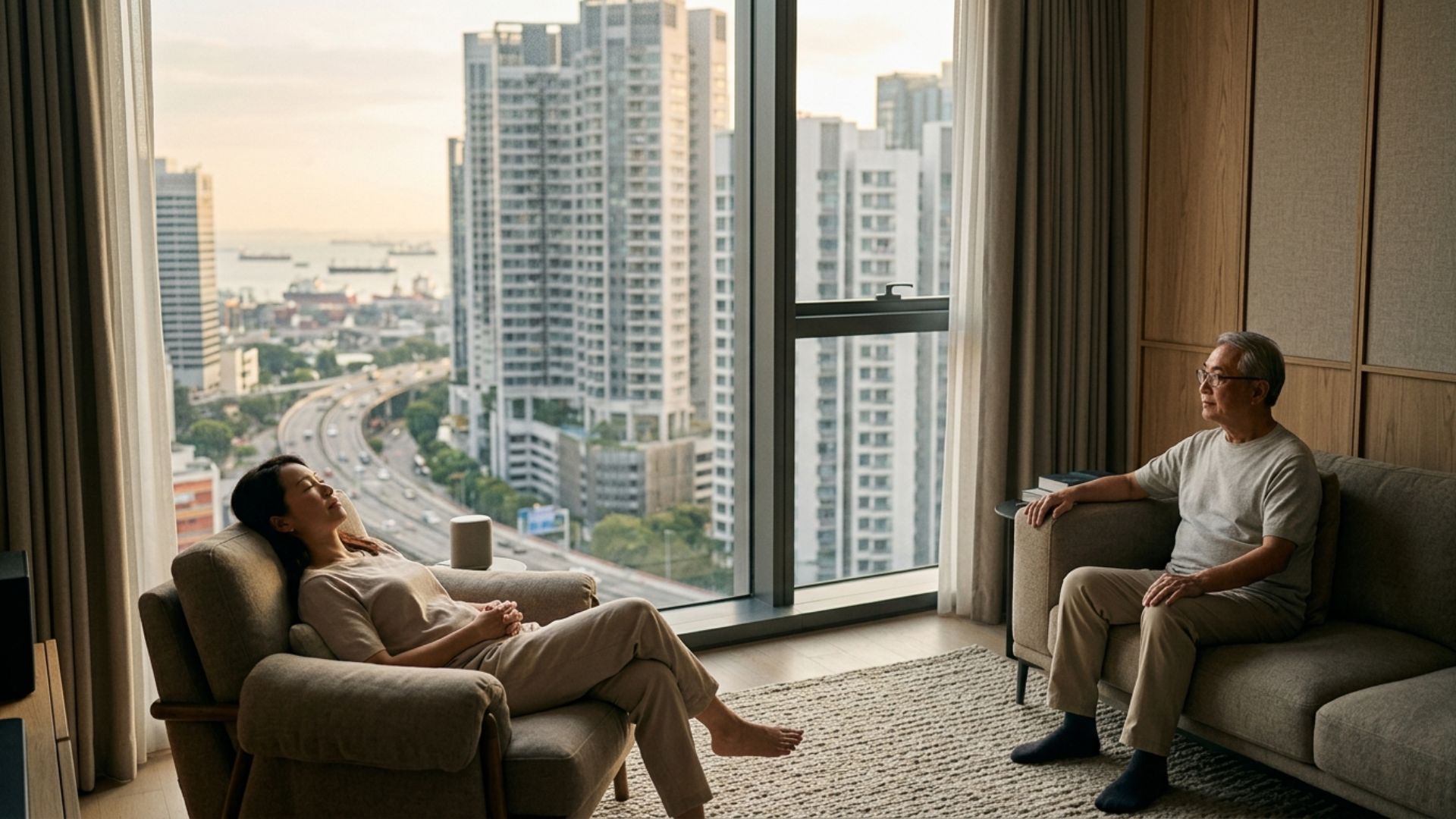
Acoustics & comfort · Singapore homes The sound of home: designing for quiet in a vertical city Singapore's high-rise living brings neighbours closer than walls suggest. Yet the interiors we remember most fondly are never the loudest — they are the ones that somehow held the noise at bay. By Darren Koh April 2026 6 min read Sound travels in Singapore homes in ways that most homeowners never anticipate until they are already living with the consequences. A neighbour's television through a shared concrete slab. The impact of footsteps from the unit above arriving as a dull, percussive thud at the ceiling. A child practising piano two floors down, perfectly audible through a bathroom wall. Construction from a development two streets over, arriving as a low, persistent vibration that no door can block. This is the acoustic reality of high-density vertical living, and it is one that Singapore's interior design conversation has been slow to address. Homeowners spend considerable thought and budget on how their homes look. They spend almost none on how their homes sound — until the first sleepless night, or the first argument conducted in tense whispers because the walls are thin, at which point the oversight becomes urgent and expensive to fix. Acoustic comfort is not a luxury. It is one of the primary conditions of a home that genuinely supports rest, concentration, and the recovery that a life in Singapore's pace-driven city demands. And unlike many aspects of interior design, it is not primarily an aesthetic question. It is an engineering question — one that must be answered early, while walls are open and floors are bare. "Every client tells us they want a calm home. Very few initially connect that desire to sound. By the end of a project, it is always the acoustic decisions they are most grateful for — and most relieved they made before the renovation closed everything up." Two kinds of noise, two kinds of solution Acoustic problems in Singapore homes fall into two broad categories, and confusing them leads to solutions that do not work. Airborne noise — voices, music, traffic, television — travels through the air and transmits through lightweight partitions, windows, and gaps around doors. Impact noise — footsteps, dragging furniture, a dropped object — travels through the structure itself, through concrete slabs and columns, arriving as vibration rather than sound waves. Soft furnishings — curtains, rugs, upholstered furniture, acoustic panels — address airborne noise by absorbing sound within a room, reducing echo and reverberation. They do essentially nothing for impact noise, which requires mass and decoupling at the structural level: a floating floor system, a resilient ceiling mount, or additional mass in a wall assembly. Many homeowners install thick curtains and plush rugs hoping to solve a thumping neighbour upstairs, and are baffled when it makes no difference. The noise they are experiencing requires a different class of intervention entirely. What can actually be done in an HDB Singapore's HDB regulations impose constraints that limit some acoustic interventions — structural modifications are restricted, and the concrete frame of a public housing block is shared infrastructure that cannot be altered. Within these constraints, however, there remains significant room for improvement at the renovation stage. Floating floor systems — in which the finished floor is laid on resilient mounts or a continuous isolation membrane rather than directly on the concrete slab — meaningfully reduce the transmission of impact noise both upward and downward. In a home with children, or in a unit beneath a household that moves actively at night, this is one of the highest-value investments a homeowner can make. It adds cost and a small amount of floor height, both of which must be planned for from the beginning of a renovation. Solid-core doors, fitted with proper perimeter seals and door bottoms that compress on closing, perform dramatically better than the hollow-core doors that come as standard in most Singapore units. The gap beneath a standard internal door is acoustically equivalent to leaving the door ajar — a sealed door bottom eliminates this entirely. These are small, relatively affordable changes that produce immediately perceptible results. Windows are often the primary entry point for external airborne noise, particularly in units facing main roads or MRT lines. Laminated glass performs better than standard glass at blocking traffic and low-frequency noise. Secondary glazing — a second pane installed inside the existing window frame, creating an air gap — performs better still, and is reversible, making it viable even in rental properties. "Quiet is not the absence of sound. It is the presence of sound you have chosen. A home that manages its acoustics well does not feel silent — it feels as though it is listening only to you." Soft furnishings as the finishing layer Once structural and construction-phase interventions are in place, soft furnishings complete the acoustic picture by managing what happens within the room itself. Hard parallel surfaces — bare concrete floors, glass walls, plaster ceilings — create a live, reverberant acoustic environment where sound bounces and accumulates, making a room feel louder than the actual sound sources would suggest. This is the acoustic quality of a room that many people describe as feeling cold or tiring, without being able to explain why. Introducing absorptive surfaces breaks up reflections and shortens the reverberation time, making the room feel warmer and more intimate without changing its physical dimensions. A large wool or cotton rug is the single most effective intervention in a hard-floored living room. Full-length curtains in a substantial fabric — linen, velvet, heavy cotton — contribute significantly even when open, as the fabric folds absorb sound from multiple angles. Upholstered furniture, bookshelves filled with books, and wall-mounted textile panels all contribute to the same effect. The acoustic quality of a well-furnished Singapore home is not accidental. It is the cumulative result of many materials, each absorbing a small portion of the energy in the room, together producing the particular hush that makes a space feel like somewhere you can think, rest, and be genuinely present. Designing for silence as an act of care There is a deeper dimension to acoustic design that rarely appears in renovation conversations but is felt in every home that gets it right. A quiet home is an act of care — for the people who live in it, and for the neighbours who share the structure around it. A home with a well-isolated floor is a home whose occupants have decided that their midnight movements need not disturb the family below. A home with solid doors and sealed thresholds is a home whose bedrooms offer real refuge from the living spaces, where a sleeping child or a resting adult is protected from the sounds of the household continuing around them. In a city as dense and fast-moving as Singapore, the home's most important function may be exactly this: to be somewhere the noise of the city does not reach. That quality does not arrive automatically with four walls and a roof. It must be designed. And the time to design it is before the renovation begins, not after the first sleepless night reveals what was left undone.
Planning a renovation?
Get matched with vetted firms that fit your budget and style — free.
Get matched