Tiles that tell stories: the return of Peranakan motifs in Singapore homes
After decades of minimalism, Singapore homeowners are rediscovering the vivid geometry of their heritage — one encaustic tile at a time.
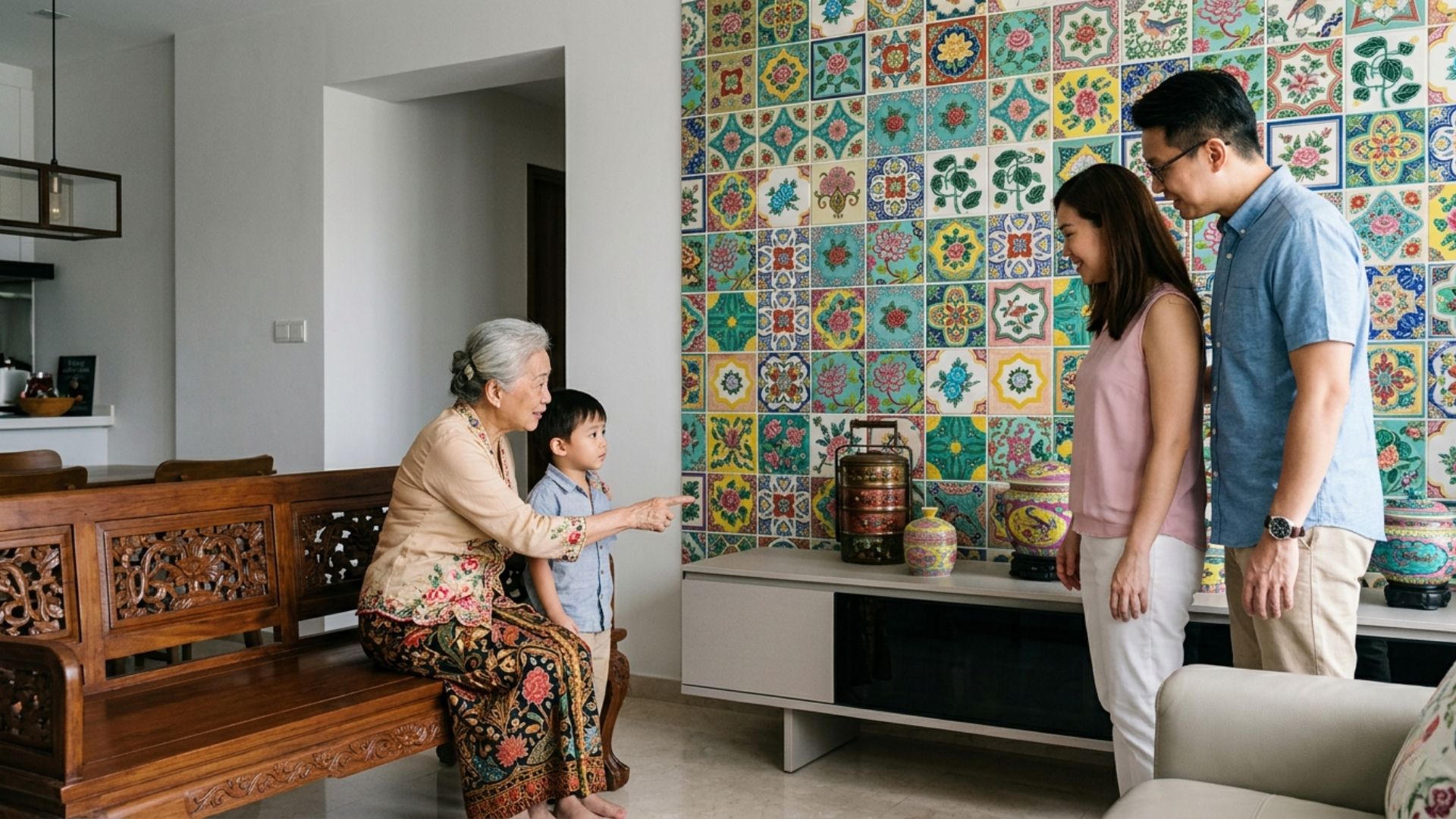
There is a floor in the Baba House on Neil Road that stops most visitors in their tracks. It is a mosaic of hand-pressed encaustic tiles — dusty rose, cobalt, ivory, and sage — arranged in a repeating floral geometry that seems to hum with quiet energy. For many Singaporeans, that floor is a memory as much as it is a surface. It recalls a grandmother's corridor, a shophouse kitchen, a childhood spent on cool cement in the afternoon heat. That memory is having a significant moment in Singapore interior design. After nearly two decades of pared-back neutrals — white walls, grey concrete, blonde timber — homeowners are increasingly reaching back toward the decorative vocabulary of their Peranakan heritage. Encaustic cement tiles, hand-painted porcelain accents, and the layered colour palettes of the Straits Chinese aesthetic are appearing in HDB flats, terrace houses, and high-rise condominiums across the island. This is not mere trend-chasing. It is something more considered: a renegotiation of what it means to feel at home in Singapore.What makes Peranakan design distinctive The Peranakan aesthetic — born from the intermingling of Chinese, Malay, and colonial European influences along the Straits of Malacca — is defined by its fearlessness with pattern and colour. Tiles feature stylised phoenixes, peonies, lotus flowers, and geometric borders in palettes that should, by any conventional design logic, clash. Dusty coral alongside peacock teal. Ivory against deep forest green. Mustard bordering on lavender. And yet they do not clash. They cohere. The reason is craft: each design is built on a rigorous underlying geometry, and the colours, however bold, are consistently muted by the natural pigments used in traditional encaustic production. The result is richness without harshness — warmth that ages gracefully rather than fading awkwardly. This quality is precisely what makes Peranakan motifs so well-suited to Singapore's interior climate. In a country where natural light is intense and walls can feel either stark or oppressive depending on the hour, the gentle saturation of heritage tile palettes absorbs light in the way that flat paint cannot. How contemporary designers are using these motifs The revival is not literal. Few designers are recreating the full Baba house aesthetic — the carved timber screens, the heavily lacquered furniture, the ornate altar tables. Instead, they are extracting specific elements and placing them in dialogue with contemporary interiors. The most common application is the bathroom. A Peranakan-patterned encaustic tile floor paired with plain white wall tiles and brushed brass fittings has become a signature look in Singapore renovation photography over the past two years. The tile does the work; everything else steps back. It is a restrained deployment of a traditionally exuberant design language — and it works because the contrast between the patterned floor and the plain walls makes both more legible. Kitchen splashbacks are the second major territory. Hand-painted ceramic tiles in soft florals or geometric borders bring texture and narrative to what is otherwise a purely functional surface. Clients who find a fully patterned floor too committed often find that a single row of decorative tiles along the splashback satisfies the same design instinct at a lower commitment level.Sourcing and authenticity The growing demand for heritage tile has produced a correspondingly varied supply. At the high end, artisan studios in Penang and Malacca still produce hand-pressed encaustic cement tiles using traditional pigment and mould techniques. These tiles are irregular in the most beautiful sense — each piece varies slightly from the next, and the floor they produce has the life of a hand-made object. A wider range of machine-produced options are available from manufacturers in Italy, Spain, and increasingly Vietnam, where heritage Peranakan patterns are reproduced at scale. These are more consistent underfoot and considerably less expensive, but they lack the depth of surface that comes from traditional production. For high-traffic areas like kitchen floors, the more uniform machine tile is often practical. For a feature wall or a powder room where the tile will be seen at close range, the handmade version repays the additional investment. We advise clients to handle samples in their own home before ordering. Peranakan tile palettes that appear warm and earthy in a showroom's controlled lighting can read quite differently in a west-facing Singapore kitchen at 4pm. Request samples generous enough to lay on the actual floor or wall surface, and observe them across a full day of light. Living with pattern The most common anxiety clients express about incorporating Peranakan tiles is the fear of overcommitting — of laying a patterned floor and finding, six months later, that it has become overwhelming. This fear is usually larger than the reality. Pattern that is well-chosen for a space tends to recede into the background of daily life in the same way that a textured wall or a timber grain does. It becomes part of the room's personality rather than its focal point. The rooms that feel overwhelming are rarely the ones with the most pattern. They are the rooms where pattern and furniture and accessories are all competing simultaneously. The solution is not less tile — it is more restraint in everything else. Keep furniture silhouettes simple. Keep soft furnishings in plains or subtle textures. Let the floor tell its story, and furnish around it as an audience, not a competing narrator. Singapore's design heritage is extraordinarily rich, and for much of the past two decades it has been politely set aside in favour of aesthetics borrowed from elsewhere. The tiles are coming back. And with them, something that feels like recognition — the particular pleasure of a home that knows where it comes from.
Planning a renovation?
Get matched with vetted firms that fit your budget and style — free.
Get matched